
The AI-First Company Structure: How Businesses Will Be Organized in the Future
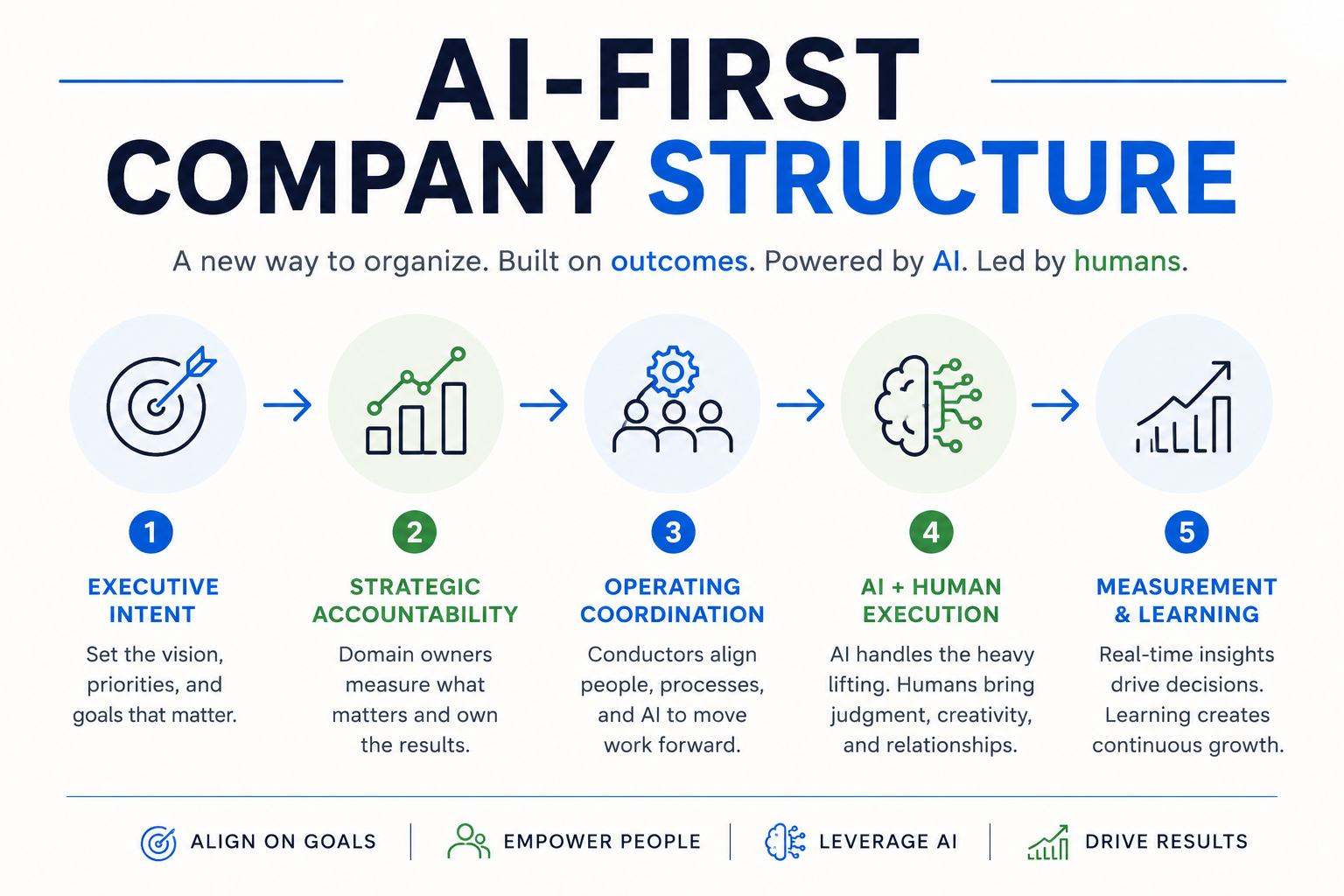
For decades, companies have been built around people, departments, managers, meetings, and tasks.
That structure made sense for a long time. Work was mostly done by humans. Information moved slowly. Managers were needed to collect updates, assign work, check progress, and make sure people stayed aligned. Departments existed because each area of the business required specialized knowledge, dedicated people, and its own systems.
But artificial intelligence is changing the way work gets done.
This does not mean humans are going away. It does not mean companies will be run entirely by AI. And it does not mean every business needs to throw out its org chart tomorrow.
What it does mean is that the traditional company structure is starting to show its age.
The future company will not be organized only around titles, departments, and reporting lines. It will be organized around outcomes, accountability, decision rights, data, human judgment, and AI-supported execution.
That is the shift.
The companies that understand this early will have an advantage. The companies that simply bolt AI tools onto old structures may move faster for a while, but they will also create more confusion, more noise, and more unmanaged risk.
The future belongs to companies that know how to combine human judgment with AI-enabled execution.
The Old Company Structure
Most companies today are still built around a familiar model:
CEO
Executive team
Departments
Managers
Employees
Tasks
The CEO sets the direction. Department heads manage their areas. Managers supervise employees. Employees complete tasks. Meetings are used to coordinate work. Reports are used to measure performance. Software tools are used to manage communication, projects, calendars, finances, customer relationships, and documents.
This structure works, but it has some obvious weaknesses.
Information often gets trapped inside departments. Managers spend too much time chasing updates. Employees complete tasks without always understanding how those tasks connect to larger goals. KPIs are tracked, but not always acted on. Projects move forward, but not always in the right priority order. The founder, CEO, or senior leader often becomes the glue holding everything together.
In small and medium-sized businesses, this problem is even more visible. The owner may be the strategist, salesperson, operations leader, finance reviewer, customer escalation point, and final decision-maker all at once. The business may have tools, but the tools do not create clarity by themselves.
A CRM can show the sales pipeline, but it does not automatically tell the company what to do next.
A project management tool can track tasks, but it does not always confirm whether those tasks support the right business goals.
An accounting system can show financial results, but it does not explain the operational changes needed to improve those results.
A dashboard can display numbers, but numbers without interpretation rarely change behavior.
That is the limitation of the old structure. It organizes people and work, but it often fails to create a clear path from strategy to measurable action.
The AI-First Company Structure
An AI-first company is not simply a company that uses ChatGPT, automation tools, or AI features inside existing software.
An AI-first company is a company that redesigns how work is understood, assigned, executed, reviewed, and improved.
The new structure looks more like this:
Executive Intent → Strategic Accountability → Operating Coordination → Human and AI Execution → Measurement → Learning
In simpler terms:
The company sets goals.
The goals are connected to KPIs.
The KPIs reveal what needs attention.
Strategic owners interpret what the numbers mean.
Operating leaders coordinate the work.
Humans and AI agents execute the work.
Results are measured.
The company learns and adjusts.
This is a very different model from simply assigning tasks down an org chart.
The AI-first company is organized around the question:
What outcome are we trying to improve, and who or what is accountable for moving it?
That question changes everything.
Today’s Company vs. the AI-First Company
The difference between today’s company and the AI-first company is not just technology. It’s operating logic.
Traditional Company
Organized around departments
Jobs defined mainly by title
Managers assign and check work
KPIs are reviewed periodically
Tasks are created manually
AI is used as a personal productivity tool
Meetings are used to gather updates
Data lives in separate tools
Strategy and execution are often disconnected
People are measured by activity
AI-First Company
Organized around outcomes and domains
Roles defined by accountability
Conductors coordinate people, systems, and AI agents
KPIs are continuously monitored and interpreted
Actions are generated from goals, KPIs, and performance signals
AI is embedded into workflows with human oversight
Meetings are used to make decisions and remove blockers
Data is interpreted across systems
Strategy, KPIs, actions, and execution are linked
People are measured by outcomes, judgment, and system improvement
The New Layers of the AI-First Company
The AI-first structure has several important layers.
These layers may look different depending on company size, industry, and maturity, but the logic is consistent.
1. The Executive Intent Layer
This is the CEO, founder, owner, or executive leadership layer.
This layer is responsible for direction.
It owns the vision, annual goals, major priorities, capital allocation, cultural standards, risk tolerance, and final accountability.
In the old model, the CEO often became the person who had to know everything. In the AI-first model, the CEO should not be buried in every operational detail. The CEO’s job is to define what matters and make sure the company has a system for turning that direction into action.
The CEO should still ask:
Where are we going?
What matters most this year?
What are we willing to say no to?
What risks are acceptable?
What kind of company are we building?
Where does human judgment need to remain central?
AI can help the CEO think, analyze, summarize, and scenario-plan. But AI does not replace executive responsibility.
2. The Strategic Accountability Layer
This is where the company begins to shift from departments to domains.
A domain is an area of business accountability. Examples include revenue, marketing, operations, finance, customer experience, people, technology, product, service delivery, process improvement, and growth.
In a small company, one person may own several domains. In a larger company, each domain may become a formal department with leaders, managers, budgets, and teams.
The important distinction is this:
A department is an organizational container.
A domain is an accountability area.
The AI-first company starts with accountability.
A strategic domain owner is responsible for interpreting performance and deciding what needs attention. This person does not just manage tasks. They own outcomes.
For example, a revenue domain owner is not simply responsible for “sales activity.” They are responsible for pipeline health, conversion rate, follow-up discipline, revenue quality, forecast accuracy, and the actions needed to improve those numbers.
A finance domain owner is not just responsible for bookkeeping. They are responsible for cash visibility, margin awareness, profitability signals, financial risk, and the decisions needed to strengthen the business.
A customer experience domain owner is not just responsible for responding to customers. They are responsible for retention, satisfaction, onboarding quality, escalation patterns, and customer trust.
This is where AI becomes very useful. AI can monitor trends, summarize changes, flag anomalies, compare performance over time, and suggest possible next steps. But the human domain owner is still accountable for interpretation and judgment.
3. The Operating Coordination Layer
This may be the most important new layer.
In traditional companies, managers often supervise people. In AI-first companies, there is an increasing need for people who coordinate outcomes across humans, tools, workflows, and AI agents.
I call this role the Conductor.
The title may vary. In a real company, this person might be called an operations manager, chief of staff, project manager, program manager, revenue operations lead, implementation manager, or business operations manager.
The title matters less than the function.
A Conductor is responsible for turning priorities into coordinated work.
They ask:
What goal does this support?
What KPI are we trying to move?
What actions are required?
Who owns each action?
What can AI assist with?
What needs human review?
What is blocked?
What decision is needed?
What should be escalated?
What changed since last week?
This role becomes critical because AI can generate more ideas, more summaries, more drafts, more tasks, and more recommendations than a company can realistically act on.
Without a Conductor, AI creates noise.
With a Conductor, AI becomes leverage.
4. The Human and AI Execution Layer
This is where work gets done.
In the old company, execution was mostly performed by employees, contractors, vendors, and software tools.
In the AI-first company, execution is performed by a hybrid workforce: humans, AI agents, automations, and specialized systems.
AI agents may monitor KPIs, summarize meetings, draft emails, prepare reports, identify stale opportunities, suggest SOP updates, generate project plans, review documents, analyze customer feedback, or create first drafts of internal recommendations.
Humans remain essential for judgment, relationships, leadership, creativity, trust, ethics, negotiation, sensitive conversations, and final decisions.
The future is not “humans or AI.”
The future is:
Humans for judgment. AI for leverage. Systems for consistency.
The companies that win will know which work belongs where.
5. The Governance and Decision Rights Layer
This layer is often ignored, but it will become increasingly important.
As AI systems become more capable, companies must define what AI can and cannot do.
Can AI observe?
Can AI recommend?
Can AI draft?
Can AI create tasks?
Can AI update records?
Can AI send messages?
Can AI approve decisions?
Can AI take action without human review?
The answer should not be the same for every workflow.
Some workflows are low-risk. For example, AI might summarize internal meeting notes or draft a checklist.
Some workflows are medium-risk. For example, AI might prepare a customer follow-up email that requires approval.
Some workflows are high-risk. For example, pricing changes, hiring decisions, firing decisions, legal commitments, financial approvals, and sensitive customer escalations should remain human-controlled.
This is where companies need an AI authority ladder:
Observe
Recommend
Draft
Create proposed actions
Execute with approval
Execute within approved rules
Escalate to human
Human-only decision
This is not bureaucracy. It is how companies scale AI safely.
McKinsey has described the future of work as increasingly “agentic,” with companies needing to manage a hybrid of humans and AI agents rather than treating AI as a simple productivity add-on. Deloitte has also argued that companies cannot simply add agents to old operating models; roles, workflows, supervision, and decision rights need to be redesigned around human-agent collaboration.
That is the point. The structure has to change.
The New Role Model: Hiring for Accountability, Not Titles
One of the biggest changes in the AI-first company is how roles are defined.
Companies have traditionally hired for titles.
They say:
We need a marketing manager.
We need a sales manager.
We need an operations manager.
We need an assistant.
We need a project manager.
Those titles may still be used, especially on job boards. But internally, the AI-first company needs to define roles by accountability.
Instead of asking, “What title do we need?” the company should ask:
What outcome is not being owned?
What KPI is not moving?
What work is falling through the cracks?
What decisions are bottlenecked?
What process is inconsistent?
What work could AI support?
What human judgment is missing?
That leads to better hiring decisions.
For example, instead of hiring a generic operations manager, a company may need someone accountable for workflow consistency, project follow-through, process documentation, and AI-assisted coordination.
Instead of hiring a generic marketing coordinator, a company may need someone accountable for campaign execution, content cadence, lead quality tracking, and AI-assisted content production.
Instead of hiring an administrative assistant, a company may need an operations coordinator who can manage meeting follow-up, action tracking, document organization, and AI-supported administrative workflows.
The title can stay familiar. The accountability must become clearer.
The Core Roles in an AI-First Company
The future company will still have CEOs, managers, specialists, and employees. But several roles will become more important.
Strategic Domain Owner
This person owns a business outcome.
They may be a head of sales, operations manager, finance lead, marketing manager, customer success manager, or general manager.
Their job is to interpret performance and decide what matters next.
They are accountable for goals, KPIs, priorities, decisions, and tradeoffs inside their domain.
Operating Conductor
This person turns strategy into coordinated execution.
They manage the operating rhythm, follow up on actions, coordinate people and AI workflows, identify blockers, and make sure the right work is moving forward.
They are not just a task manager. They are the bridge between strategic priorities and execution.
AI Workflow Owner
This person helps the company use AI responsibly inside real workflows.
They identify use cases, document repeatable processes, manage prompts or playbooks, test AI outputs, train employees, and maintain approval rules.
In smaller companies, this may be part of an operations role. In larger companies, it may become its own role.
Data and KPI Owner
This person makes sure the company’s numbers are reliable.
AI depends on data quality. If the CRM is messy, the financial reports are late, or KPI definitions are unclear, AI will confidently analyze bad information.
The Data and KPI Owner protects the quality of the company’s operating signals.
Process Owner
This person makes work repeatable.
They own SOPs, handoffs, training materials, quality standards, and process improvement.
AI performs better when the business has clear processes. If the process is messy, AI may simply automate confusion.
Human Relationship Owner
This person owns trust.
AI can support customer communication, sales follow-up, onboarding, account management, and employee support. But human relationships still matter deeply.
This role is responsible for nuance, empathy, escalation, negotiation, and trust.
AI Governance Owner
This person or group defines the rules for safe AI use.
They are responsible for data access, permissions, approval levels, audit trails, tool selection, risk management, and escalation paths.
At a small company, this may be the founder, COO, or outside advisor. At a larger company, it may become a formal governance function.
How the Structure Changes by Company Size
The AI-first structure does not look the same at every stage.
A $1 million company should not copy the structure of a $100 million company. But both companies need the same basic logic: goals, KPIs, accountability, coordinated execution, AI leverage, human judgment, and learning loops.
$1M–$3M: Founder-Led AI Leverage
At this stage, the founder is usually still the main strategist, salesperson, decision-maker, and problem-solver.
The company does not need a complex org chart. It needs clarity and follow-through.
The most important roles are:
Founder / CEO
Operations Conductor
Administrative or operations coordinator
Bookkeeper or finance support
Core delivery or sales team
The first AI-forward hire is often not a senior AI expert. It is usually an organized operations person who can help the founder turn decisions into actions, document processes, manage follow-up, and use AI to reduce administrative drag.
The goal at this stage is simple:
Get the business out of the founder’s head.
$3M–$5M: Functional Accountability
At this stage, the founder can no longer own every function.
The company needs clear owners for sales, marketing, operations, finance, and customer experience. These may not all be full-time executives. Some may be managers, fractional leaders, contractors, or strong internal team members.
The key shift is that people stop being responsible only for activity and start being responsible for outcomes.
Sales owns pipeline health and conversion.
Marketing owns lead generation and message quality.
Operations owns delivery consistency.
Finance owns cash and margin visibility.
Customer experience owns retention and satisfaction.
AI can help each area monitor patterns, summarize performance, and recommend action. But each area still needs a human owner.
$5M–$10M: Cross-Functional Coordination
This is where companies often start to feel chaotic.
There are now enough people and functions that departments can become disconnected. Sales may sell work that operations struggles to deliver. Marketing may generate leads that sales does not follow up on. Finance may report problems after it is too late to correct them. Customer issues may reveal process problems that no one owns.
The company now needs stronger operating coordination.
This is where a chief of staff, director of operations, business operations manager, or program lead becomes highly valuable.
The company also needs better reporting, cleaner data, and a more formal weekly operating rhythm.
The key question becomes:
Are teams working together to move company goals, or are they optimizing their own departments?
$10M–$20M: Formal Leadership and Governance
At this stage, informal leadership starts to break down.
The company needs a real leadership team, clearer decision rights, better forecasting, stronger systems, and more formal governance.
AI use also becomes more serious. It is no longer just a few employees using AI to write emails or summarize notes. AI may begin touching customer communication, reporting, operations, hiring workflows, sales analysis, knowledge management, and financial interpretation.
That means the company needs rules.
Who can use AI?
What tools are approved?
What data can be used?
What requires human approval?
What must be logged?
Who reviews AI-generated recommendations?
Who owns the outcome if AI makes a mistake?
This is where AI governance becomes a leadership responsibility.
$20M–$50M: Distributed Accountability
At this stage, the company may have multiple locations, customer segments, product lines, service lines, or business units.
The CEO cannot be the center of every decision.
The company needs distributed accountability.
Business unit leaders, domain owners, program managers, data leaders, and process excellence roles become more important.
AI can help connect the system, but only if the company has clear accountability and clean data. Otherwise, AI will amplify confusion across more people, more systems, and more processes.
The key challenge is balancing speed with control.
Teams need enough autonomy to move quickly, but the company still needs shared goals, shared KPI definitions, shared operating standards, and shared governance.
$50M–$100M: Enterprise Operating System
At this stage, AI is no longer just a productivity layer. It becomes part of the company’s operating infrastructure.
The company needs enterprise-level leadership around data, systems, AI governance, process excellence, workforce transformation, and strategic execution.
The AI-first structure now includes:
Executive leadership
Business unit leaders
Domain owners
Operating conductors
Data and analytics teams
AI governance leaders
Process excellence teams
Workforce enablement leaders
Human relationship owners
AI-supported execution networks
At this size, the question is no longer, “Should we use AI?”
The question is:
How do we redesign the company so humans and AI can work together safely, effectively, and profitably?
The World Economic Forum’s Future of Jobs Report 2025 highlights technology change, including AI, as a major force reshaping jobs, skills, and workforce strategies through 2030. That means companies should not treat this as a software adoption issue. It is a workforce and operating model issue.
What Existing Companies Should Start Doing Now
Most companies do not need to reorganize overnight.
But they should start preparing now.
1. Clarify Goals
AI cannot help a company execute well if the company is unclear about what it is trying to accomplish.
Start with a few clear annual goals. Then define quarterly priorities that support those goals.
Avoid creating too many goals. The more goals a company has, the harder it becomes to focus.
2. Connect KPIs to Goals
Every major goal should have a few KPIs that show whether the company is making progress.
Do not track metrics just because they are available.
Track the numbers that actually influence decisions.
For example:
Revenue growth
Gross margin
Lead conversion
Customer retention
Cash flow
Delivery speed
Client satisfaction
Employee capacity
Quote turnaround time
Project completion rate
KPIs should not be decoration. They should guide behavior.
3. Map Accountability
For each goal and KPI, define who owns it.
Not who is “involved.”
Not who “helps.”
Who owns it.
Every company should be able to answer:
Who owns sales conversion?
Who owns cash visibility?
Who owns customer retention?
Who owns delivery quality?
Who owns process documentation?
Who owns employee onboarding?
Who owns data quality?
Who owns AI governance?
If the answer is “everyone,” the real answer is usually “no one.”
4. Identify the Operating Bottlenecks
Before adding AI, companies should identify where work is already breaking down.
Where are things slow?
Where is follow-up inconsistent?
Where does the founder get pulled back in?
Where do customers get frustrated?
Where do tasks fall through the cracks?
Where are decisions delayed?
Where is data unreliable?
Where are processes undocumented?
These are the areas where AI may help, but only after the workflow is understood.
5. Assign a Conductor
Every growing company needs someone responsible for follow-through.
This may be an operations manager, chief of staff, project manager, or senior coordinator.
The title does not matter as much as the accountability.
This person makes sure goals become actions, actions become assigned work, work gets completed, blockers are escalated, and results are reviewed.
AI can support this person heavily. But someone still needs to conduct the work.
6. Clean Up Data
AI-first companies require trustworthy data.
That does not mean the company needs a perfect data warehouse on day one.
It does mean the company needs basic hygiene.
CRM records should be accurate.
Financial data should be current.
Project statuses should be reliable.
Customer records should be organized.
KPI definitions should be clear.
Documents and SOPs should be findable.
Bad data creates bad AI recommendations.
7. Document Core Processes
SOPs are no longer just training documents.
In an AI-first company, process documentation becomes part of the company’s intelligence layer.
AI can summarize, improve, and help execute processes, but only when those processes are defined.
Start with the most important workflows:
Sales follow-up
Customer onboarding
Quote or proposal creation
Project delivery
Invoicing and collections
Employee onboarding
Customer escalation
Weekly reporting
Monthly review
Do not try to document everything at once. Start with the workflows that create the most risk or repetition.
8. Define AI Authority Levels
Companies should decide how much freedom AI has in each workflow.
A simple model is:
AI can observe.
AI can recommend.
AI can draft.
AI can create proposed tasks.
AI can update low-risk records with approval.
AI can execute within approved rules.
AI must escalate sensitive decisions.
Some decisions remain human-only.
This prevents two common problems: employees being afraid to use AI at all, and employees using AI recklessly without boundaries.
9. Train People Differently
AI training should not only teach people how to write prompts.
Employees need to learn:
How to use AI in their role
How to check AI output
How to protect sensitive data
How to recognize bad recommendations
How to escalate uncertainty
How to document decisions
How to improve workflows
How to work with AI without giving up human judgment
Companies should hire for curiosity, accountability, communication, judgment, and adaptability. AI tools will change. Those traits will remain valuable.
10. Build a Learning Loop
The AI-first company should get smarter over time.
Every week, the company should ask:
What changed?
What worked?
What did not work?
What did we learn?
What should we stop doing?
What should we automate?
What needs human judgment?
What process needs to improve?
This learning loop is what separates an AI-first company from a company that merely uses AI tools.
What Companies Should Avoid
There are several traps companies should avoid.
Trap 1: Adding AI to Broken Processes
If a process is unclear, AI will not magically fix it. It may simply make the broken process faster.
Before automating or augmenting a workflow, understand the workflow.
Trap 2: Confusing Activity With Progress
AI can generate more content, more tasks, more reports, and more suggestions.
That does not mean the business is improving.
Progress should be measured by KPI movement, customer outcomes, margin improvement, speed, quality, retention, and decision quality.
Trap 3: Replacing Judgment Too Early
AI can assist with analysis, but it should not own every decision.
Human judgment still matters most in strategy, ethics, relationships, leadership, hiring, firing, negotiation, and sensitive customer issues.
Trap 4: Letting Every Department Use AI Differently
Experimentation is good, but total inconsistency creates risk.
Companies need shared standards for tools, data, security, approval, and documentation.
Trap 5: Thinking AI Is Only an IT Issue
AI-first transformation is not just technical.
It affects roles, accountability, management, training, workflows, performance measurement, customer experience, and culture.
This is a leadership issue.
The Future Company Is Not Less Human
The most important point is this:
The AI-first company is not less human. It should be more human where humanity matters most.
AI should reduce administrative drag, improve visibility, support decision-making, summarize complexity, and help teams execute repeatable work.
Humans should spend more time on judgment, relationships, creativity, leadership, trust, coaching, strategy, and problem-solving.
The future structure is not:
AI replaces people.
The future structure is:
Humans lead.
AI monitors.
AI recommends.
Humans decide.
AI assists.
Humans build trust.
Systems create consistency.
The company learns faster.
That is the better model.
The New Company Structure in One Sentence
The AI-first company is organized around outcomes, accountability, decision rights, human judgment, and AI-supported execution.
It is not built merely to manage people.
It is built to convert goals into measurable progress.
What to take away
The companies of the future will still need leaders, managers, specialists, coordinators, and teams.
But the way those people work will change.
The best companies will not simply ask, “How can we use AI?”
They will ask:
How should our company be structured now that AI can monitor, analyze, draft, summarize, recommend, and execute parts of the work?
That is the real question.
The answer is not to abandon the old structure completely. The answer is to evolve it.
Departments will still exist, but they will need clearer accountability.
Managers will still exist, but they will need to become better interpreters and coordinators.
Employees will still execute work, but they will work alongside AI systems.
KPIs will still matter, but they will need to trigger action.Processes will still matter, but they will need to become AI-ready.
Leadership will still matter, but it will need to become more intentional about decision rights, governance, and human judgment.
The AI-first company is not a futuristic fantasy.
It is the next evolution of business structure.
And companies can start building toward it now.